Clinically reviewed by Dr. Logan Jones, Psy.D.
You've rested, and you're still exhausted. Most burnout advice assumes you can step away for a while: take a leave, book a long vacation, or quit. For most people, that isn't an option. Recovering from burnout while still working takes two things together: rest that actually restores you, and one realistic change to what keeps draining you.
So you rest where you can. You sleep in on Sunday, skip the plans you don't have the energy for, and stay on the couch. By 4 p.m. you're still tired and already bracing for Monday's inbox.
You're not resting wrong. Rest relieves exhaustion, but it doesn't change what's causing it. When you go back to the same workload, the same lack of control, and the same people needing things from you, the tiredness comes back with them.
Key takeaways
Rest helps, but the relief fades when you go back to the same demands.
Rest restores you when it gives you mental distance from work, real relaxation, something absorbing, and time you control.
Pair better rest with one specific change to what drains you, like a moved deadline or a clear ask for help.
Fatigue that's new, getting worse, or hard to explain is worth a doctor's visit, whatever else is going on.
Why isn't rest enough to recover from burnout?
Rest isn't enough because burnout comes from ongoing conditions, and a break doesn't change those conditions. The World Health Organization (WHO) describes burnout as a syndrome that results from chronic workplace stress that hasn't been successfully managed. Its three signs are exhaustion, mental distance or cynicism about your job, and feeling less effective at work.
Think about the last vacation you came back from. For a few days, you felt lighter. Then the old routine took over, and the tiredness crept back. The break was real. So were the demands waiting on the other side.
That's why one quiet weekend is being asked to do too much. Recharging after one hard week is different from recovering after months of running past your capacity. When every break ends with a return to the same cycle, the relief never gets a chance to add up. If you're not sure the pattern fits you, start with the signs of burnout people often overlook.
Is it burnout, or is something else making you this tired?
Before you call your exhaustion burnout, rule out other causes. Exhaustion that doesn't lift with rest can be burnout, but it can also have a medical cause. The WHO notes that burnout isn't classified as a medical condition, and feeling tired after resting doesn't prove you have it.
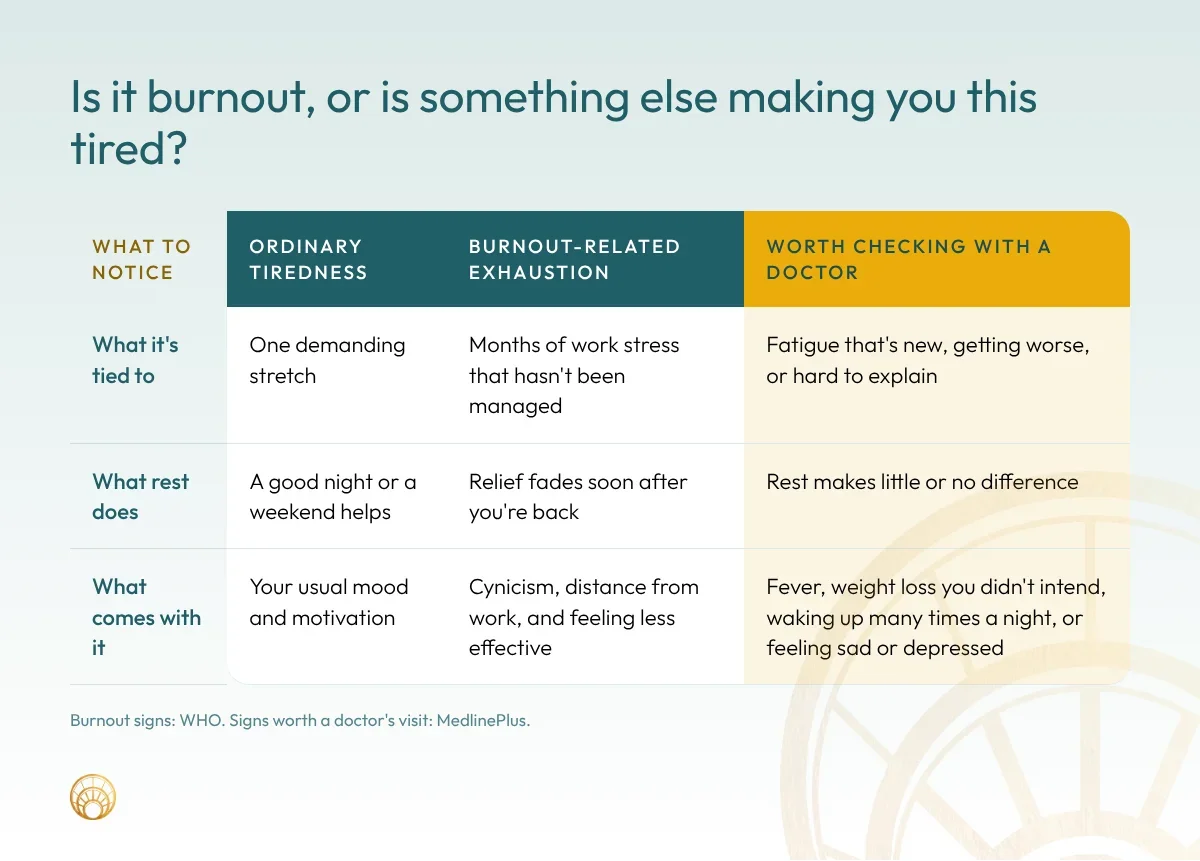
Notice what rest does, and doesn’t, change.
MedlinePlus, the U.S. National Library of Medicine's health site, lists many causes of fatigue, including anemia, thyroid problems, sleep disorders such as sleep apnea, side effects of some medicines, and depression. If your fatigue is significant, new, or getting worse, or if it's affecting how you function, talk to your doctor. You can take your stress seriously and rule out a physical cause at the same time.
If exhaustion ever comes with thoughts of harming yourself, don't wait: call or text 988, the Suicide & Crisis Lifeline, or go to the nearest emergency room.
What makes rest actually restore you?
Once you've ruled out other causes, the next question is what kind of rest helps. Rest restores you when it gives you specific experiences, not just hours off. Organizational psychologists Sabine Sonnentag and Charlotte Fritz identified four recovery experiences that help people unwind from work: detachment, relaxation, mastery, and control. In their research, these experiences were linked with psychological well-being. A weekend on the couch can give you none of them. A busy Saturday can give you all four.
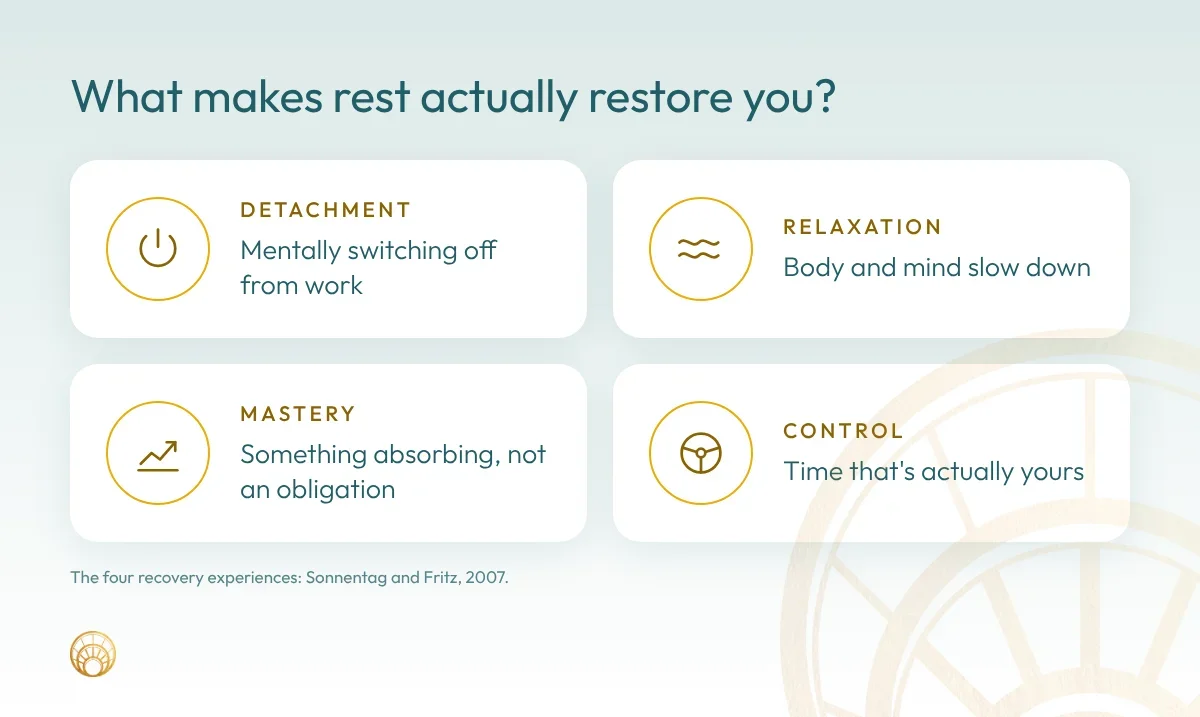
Real recovery needs more than hours off.
Detachment: are you actually off?
Detachment means mentally switching off from work, not just leaving the office. You can be on the couch and still be running Monday's meetings in your head, answering one more message, or bracing for what's waiting. That's time off without being off. For many people, the phone is where detachment breaks down: work is one notification away. If you work from home, switching off when your office is your apartment takes its own kind of planning.
Relaxation: low effort isn't the same as relaxed
Relaxation is a state where your body and mind actually slow down. Scrolling at midnight takes little effort, but it often isn't relaxing. A lot of what people call rest is closer to collapse: stopping because you can't keep going, then doing whatever takes the least energy. Collapse is understandable. It just rarely leaves you feeling restored.
Mastery: something absorbing that isn't an obligation
Mastery means doing something that challenges you a little and lets you get better at it: a class, a run, cooking something new, or a language you're learning for fun. It sounds like more effort, which is why exhausted people skip it. But it gives your mind somewhere to go besides work, and it's one of the four recovery experiences, not a bonus.
Control: time that's actually yours
Control means choosing what you do with your time off. If your weekend is organized around everyone else's needs (kids' activities, a parent's appointments, and a partner's plans), it can be full of good things and still not feel like yours. One protected hour you choose for yourself can matter more than a free afternoon that someone else fills.
A better question than "Did I rest enough?" is "What am I depleted from, and what would replenish that?"
Why does resting make you feel guilty?
Knowing what restores you is one thing. Letting yourself have it is another. Rest feels guilty when being productive, dependable, or available has become part of how you judge your worth. You finally sit down, and your mind starts listing what you should be doing instead.
Sometimes the guilt comes from a real situation: there's more to do than one person can manage, and stopping means the work waits. Sometimes it comes from an internal rule: you should handle everything without help, and time only counts if it's useful. Most people carry some of both. Knowing which is which matters. A better boundary won't shrink an unmanageable workload, and a shorter to-do list won't help much if you still feel responsible for everything around you. If perfectionism and imposter syndrome keep raising the bar, the internal rule is probably doing more of the work.
Quiet can also make exhaustion easier to notice. Staying busy keeps stress, hard feelings, and dissatisfaction in the background. When things slow down, they get louder. That discomfort isn't proof you're bad at self-care. It's information about the relationship you've built with work, responsibility, and your own needs, and that relationship is worth looking at.
How do you recover from burnout while still working?
Better rest is half of recovery. The other half is changing something about what drains you. You recover from burnout while still working by pairing better rest with one realistic change, then building from there. You don't need a sabbatical or a life overhaul to start.
Name the mismatch. Ask what drains you most: the amount of work, how little say you have over it, feeling unrewarded, strained relationships at work, unfairness, or work that clashes with your values. "Too much work" and "no say over my work" call for different changes.
Sort your demands into three piles. Fixed for now (a shift, a bill, or a child's school pickup). Negotiable, even a little (a deadline, how fast you reply, or whether a task happens this week). Support you could ask for (a colleague, a family member, or a paid service).
Make one specific ask. "I'm overwhelmed" is hard for a manager to act on. "Which of these two deadlines comes first?" or "Can this report move to next Friday?" is easier. If those conversations aren't safe where you work, write down your concerns and get advice outside the organization. Therapy for a toxic work environment can help you plan your next step.
Protect one recovery block a week. Plan it for detachment, relaxation, mastery, or control, and guard it like a meeting. Leaving your phone in another room counts.
Ask one better question. What's one part of this week that could become a little less demanding without creating a bigger problem somewhere else? If nothing comes to mind, you've found a real constraint, not a failure of effort.
Small changes won't make a permanently excessive workload sustainable, and they aren't meant to. Sometimes exhaustion is telling you that the situation itself needs to change. That's worth hearing.
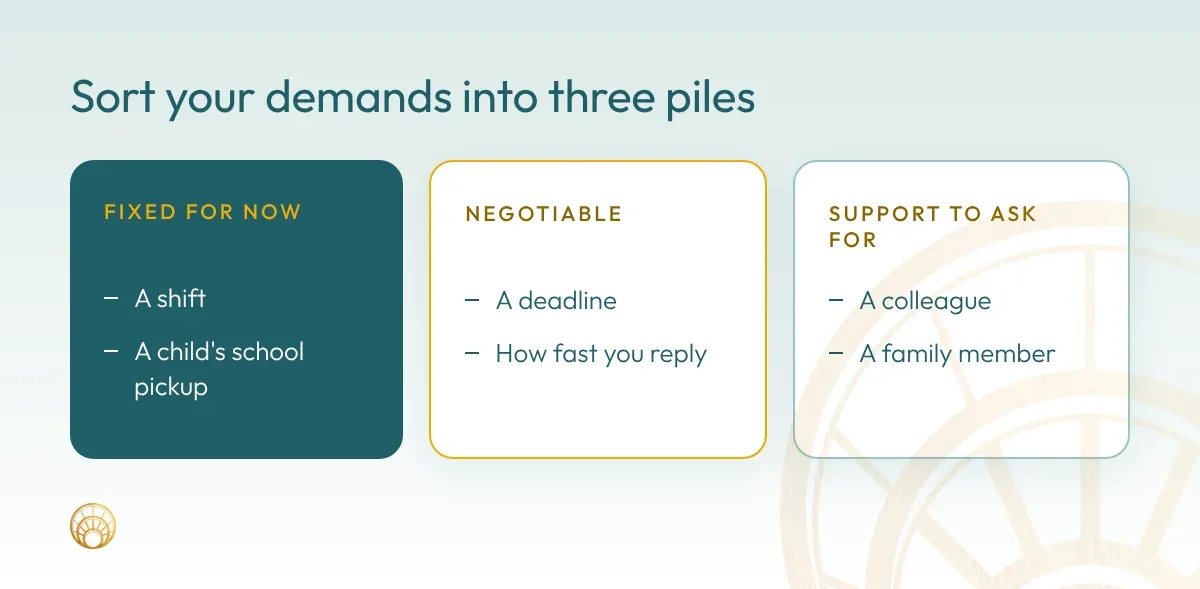
Sort first, then pick one thing from the middle column.
What if your burnout isn't only about work?
The WHO definition is about work. Real life isn't that tidy.
You might be caring for a parent, raising kids, or getting through grad school on top of a job.
That depletion deserves attention, whatever you call it.
The rule is the same: rest helps, and something about the load has to change too.
Our article on caregiver burnout and parenting stress looks at the mental load that keeps running on your day off. If you're holding down a job and caring for family, therapy for caregivers balancing work and family focuses on exactly that. And graduate school burnout has pressures of its own.
How can therapy help when rest isn't enough?
If you've tried better rest and small changes and you're still running on empty, it's time for more support. Therapy helps you see what keeps you depleted and make changes that let recovery last. Many of the people Insight Therapy NYC's therapists see have pushed through stress for so long that exhaustion feels normal. In sessions, you can look at the pressures you're carrying and the boundaries that are hard to hold. You can also look at the guilt that shows up when you slow down, and the beliefs that make putting yourself first feel uncomfortable.
Therapy also looks at your circumstances, not only your mindset. It helps you separate what you can't change right now from the places where you have more room than it feels like. It also stops exhaustion from being framed as a personal failure to cope. It won't arrange child care or cut your workload, and it doesn't replace a medical check. It gives you a steady place to make decisions that are hard to make alone. Our page on therapy for burnout in NYC explains how it works at Insight.
So why are you still exhausted after resting?
Because rest has been asked to do a job it can't do alone. Rest that restores you, plus one change to what drains you, is how recovery starts while you keep working. And if your fatigue is new, getting worse, or hard to explain, put a doctor's visit on the list too.
Rest hasn't worked. The right therapist can help you find out why.
You've tried the weekends, the early nights, and the vacation. If you're still running on empty, you need a different kind of support, not another day off. Insight Therapy NYC's therapists work with burnout, chronic stress, and the guilt that keeps capable people from slowing down, in person on Fifth Avenue and virtually across New York State. You'll work with one therapist, with a solid team behind them. If you have Northwell Direct, here's how Northwell Direct Tier 1 works for burnout and work stress therapy for eligible individual therapy.
About Insight Therapy NYC
Insight Therapy NYC is a psychotherapy practice in Manhattan offering in-person therapy on Fifth Avenue and virtual therapy across New York State. Founded by Dr. Logan Jones, the practice provides individual therapy, EMDR, and couples or family therapy for people seeking more personalized, accessible mental health care in New York City.
Clients come to the practice for support with a wide range of emotional, relational, and life challenges, and are matched with care based on their goals, preferences, and therapeutic needs. Services are designed to feel thoughtful and individualized, with care supported within a clinician-led practice environment.
The practice offers transparent out-of-pocket rates, superbills for possible out-of-network reimbursement, and Northwell Direct Tier 1 for eligible therapy services. For clients looking for therapy in Manhattan or virtual therapy in New York State, the goal is to make getting started feel clearer, more personal, and more sustainable.
Please note: Northwell Direct Tier 1 currently applies to eligible individual therapy services at Insight and does not apply to couples or family therapy.
Clinical Review & Expert Insight
Updated November 2026
Reviewed by Dr. Logan Jones, Psy.D., Founder of Insight Therapy NYC
Dr. Logan Jones is a licensed clinical psychologist and the founder of Insight Therapy NYC, as well as Clarity Therapy NYC, Clarity Health + Wellness, and Clarity Cooperative, all organizations focused on expanding access to high-quality mental health care and supporting therapist development. His work emphasizes thoughtful treatment planning, collaborative therapeutic relationships, and helping clients access approaches that fit their individual needs and goals. His insights and expertise have been featured in national and international media.
Resources
World Health Organization. Burn-out an "occupational phenomenon": International Classification of Diseases
Journal of Occupational Health Psychology. Sonnentag and Fritz (2007), The Recovery Experience Questionnaire: development and validation of a measure for assessing recuperation and unwinding from work
MedlinePlus (U.S. National Library of Medicine). Fatigue
Frequently asked questions about burnout recovery
-
There's no set timeline. It depends on how long the stress has lasted, which demands are still in place, how much support you have, and whether other health issues are involved. Recovery tends to be gradual, so be wary of any plan that promises you'll feel restored after a set number of days off.
-
Often, yes, especially when you can change something about the load. Working on one mismatch at a time (workload, control, or support), protecting time that truly restores you, and making specific asks at work can all help. Some workplaces can't be fixed through individual effort, though, and for some people, leaving becomes the right call.
-
A week off gives relief, but it can't change what you go back to. If the same workload and pressures are waiting, the tiredness tends to return with them. Time off can also stay mentally busy: if you checked messages or worried about what was waiting, you got a week away without really switching off. If the tiredness keeps going or gets worse, check with a doctor.
-
Rest brings guilt when productivity, achievement, or caring for others has become tied to your sense of worth. One part of you knows you need a break, while another reads slowing down as laziness or falling behind. Therapy can help you look at where those rules came from and build a steadier relationship with rest.
-
The most helpful rest gives you a real break from thinking about work, a chance to slow down, something absorbing, and time that's yours to choose. Sleep matters too. The right mix depends on what's draining you: constant demands call for time when nothing is expected of you, and isolation calls for time with people you enjoy.